Showing posts with label Travel and Driving. Show all posts

December 21, 2011

Another 1500km Trip

This time we were heading to the northern-most point of Malaya. Spent 3D2N around its vicinity before continuing the journey to the North-East state for a couple of days before returning home.

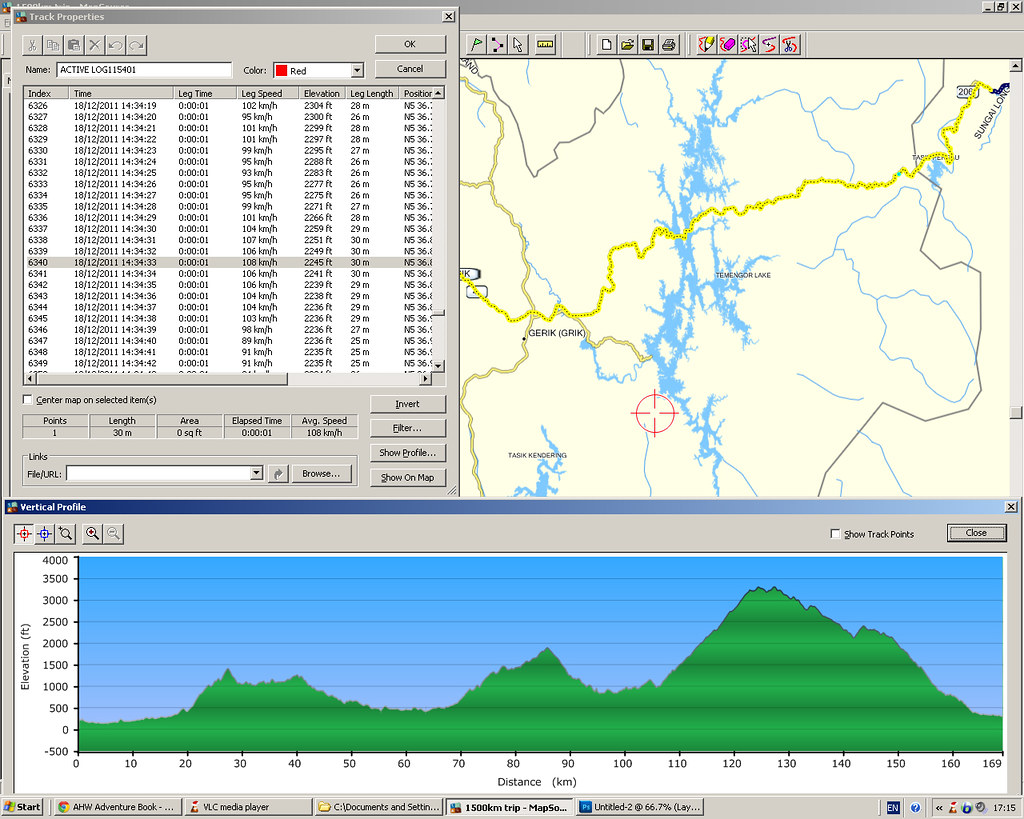
Actual tracklogs with Garmin eTrex Vista HCx for the entire 1500km trip.
1500km trip

Grik-Jeli hiway Profile
Grik hw profile
See also previous 1500km trip to the Eastern and Southern states of Peninsular Malaysia.

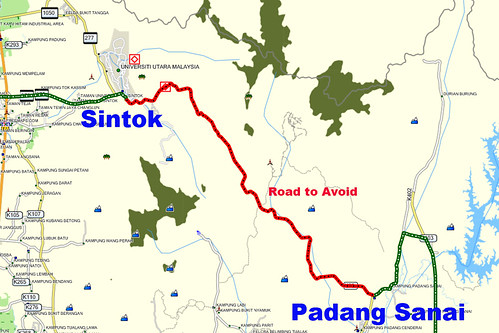
The suspension, ABS, EBD, EBA and stability control [ESP] on Peugeot 308 Turbo was tested on badly damaged and slippery road K20 between Sintok and Padang Sanai in Kedah on December 18th 2011.


This road should be avoided by all means unless you are driving on purpose.

K10 - road to avoid

October 13, 2011

2D1N at Banding

On return trip from Kelantan, stopped over at Banding Lakeside Inn, Temenggor Lake, near Royal Belum State Park for 2D1N.
click on the images to enlarge


Click for more pictures HERE

October 07, 2011

Nite Trip to Kelantan

As usual, as a "nite-rider" I'll be driving just after mid-night. I always prefer to travel in a hatch-back than in a D-segment saloon because the former like the 308 can provide a comfortable [golden-club like] sleeping berth for any passenger in need, such as an elderly father/mother, grandpa/grandma or a mother with a small baby...
As long as you are shorter than 5' 6" there is more than enough space for a good nite sleep in there...
With this arrangement, the 308 still can accommodate three adult passengers + a driver comfortably without sacrificing space for the luggage - of course you need a cargo net.

keKelantan400

June 21, 2011

Night Riders be Prepared...

I prefer to drive after midnight for non-stop long distance journeys - just like inter-continental flights from KLIA.
Reasons for a Long-Distance Night Rider
Usually I go to bed as early as 9:30pm and wake up around 2:00 - 3:00am and sleep again around midday during lunch hours w/o taking any meal because I normally take brunch at 10:00am and dinner around 5:00pm.

Danger for Night Riders!
Surely, there are fewer vehicles on the road after midnight but ironically it is the riskiest time for driving. There are many factors which increase the risk of "after midnight driving".
  • Most people on the road are likely to be tired and sleepy.
  • Headlight beam from incoming vehicles causing a nuisance to other road users which can leave them blind or black-out for up to a few seconds. The lights of vehicles 'cucuk' from behind also can cause glare.
  • Cows, water buffalo and other 'night-active' animals camouflage in the darkness, may appear suddenly on the road out of nowhere and too late for the driver to respond in time.
  • Heavy vehicles such as lorries, trucks, buses are driven by Night Riders
Night Riders be Prepared for Yourselves FIRST...
If you are going to be driving at night, no matter what your age, it is vitally important that you are prepared. If you end up making an unexpected trip in the dark and find yourself tired, it's essential that you pull over and rest in a safe place so that you are not a danger to yourself or others on the road. Remember, tired driving is as dangerous as drunk driving because your reaction time can be equally affected, plus you run the risk of falling asleep at the wheel.

Other things that you can do to make your night time trips as safe as possible.
  • Make sure that you see your eye doctor regularly for eye exams. (At least once every two years, more often if you have certain conditions. Diabetics should see their eye doctor every year.) This way any problems with night vision can be noted and dealt with. I take green tea or teh o without sugar...
  • Don't forget your vitamins. Vitamin A deficiency causes a condition called night blindness which can make it difficult or impossible to drive safely at night. I drink carrot susu...

Prepare Your Car
There are several things that you should do to get your car ready for safe night driving. This includes making it easier for you to see where you are going as well as easier for others to see where you are without causing nuisance to other road users.
Click for what I've done to Light Bulbs and Day Running Lights [DRL].
  • Make sure that your head-lights and tail-lights are all working properly. The head-light covers must be clean whenever you head out on a nighttime trip, especially when there's bad weather like rain, mist or fog. Your headlights should also be properly aimed so that they are focused and directed correctly. Click HERE.
  • Make sure that your windshield are clean so that there is no glare or obstructed vision.
  • Adjust your outside mirrors so that they are in the right place; the body of your car should be just outside of the vision of the mirrors. Your rear and side mirrors should also be adjusted so that the glare from the headlights behind you is not a problem - our 308T rear view mirror has anti-glare feature though.

While on the road
  • Night vision can be affected before the sun even goes down, so to make sure that your eyes stay sensitive.
  • Make sure that you are looking from side to side so that your eyes stay sensitive to the darkness.
  • Do not look at oncoming headlights while driving, it can leave you blind for as much as five full seconds.
  • If you are driving in the fog, use your low beams or/and fog-lights only because the high beams will not allow you to see well due to direct reflections. Make sure that you don't use your high beams if traffic is coming toward you either, and hopefully oncoming traffic will afford you the same courtesy.
  • If you find yourself staring at the white line or other fixed object for too long, you may succumb to ‘highway hypnosis,’ which will decrease your reaction time.
  • If you are driving through forest such as from Kuala Lipis to Gua Musang, use your peripheral vision to watch for animals on the sides of the road. Often times, you won't see the animal themselves, but their eyes reflecting the headlights of passing cars. If you have any passengers in your vehicle, ask them to keep watch so you can focus your attention on your driving.
  • Continually evaluate your night-time driving skills, so that you are not endangering yourself and others. Sadly, night vision tends to worsen with age, so at some point you may need to limit your night-time driving.
Night time driving can be full of unpleasant surprises, so always expect the unexpected. Make sure you're alert at all times and ready for any emergency situation that could possibly crop up. Above all else, if at any point you feel like you're not seeing clearly, find a safe spot to pull over. And if you can't remedy the situation, just wait for daylight. It's much better to arrive a little later than planned, than to risk your safety and everyone else.

Nevertheless, the advantage after midnight is smooth high-speed driving - most of the time on Auto-Cruise is possible. Also less wear & tear on brake-pads/disk, tyres, air-cond system, etc... and of course less consumption on fuel.

I will be on another inter-continental night trip soon.
Till then, so loooongggg!!!

Happy Motoring

June 05, 2011

Lowest Fuel Consumption with Petronas PRIMAX 95 Xtra!

[updated version on June 7th 2011]

After 'flushing' my 308T combustion chambers with a few tanks of the new Petronas PRIMAX 95 Xtra I decided to carry out actual tests for the fuel consumptions on different kind of driving conditions covering more than 1200km.

BBBangi - Simpang Pulai - Gua Musang - Machang & around Kelantan - Kuala Berang-Kuantan - KLumpur - BBBangi.
Day 1: June 4th 2011
Sector 1: Economy Drive [215km] - 'warming-up lap' with auto-cruise without exceeding speed limits on PLUS from BBBangi to Simpang Pulai.

Average Petronas PRIMAX 95 Xtra Consumption: 5.8liter/100km
The Best Fuel Consumption running on normal RON95 fuel was 6.2liter/100km


Sector 2: Pushing 308T to the Limits [152km] - Crossed Main Range by driving-up winding road from Simpang Pulai to Blue Valley, stopped about 45minutes to buy farm produce then continued with downhill challenge all the way to Gua Musang. At Gua Musang stopped for lunch.

Average Petronas PRIMAX 95 Xtra Consumption: 8.8liter/100km. Last test using normal RON95 fuel was 9.9liter/100km.

Sector 3: Normal Driving with lots of Traffics [145km] - Anybody who drives at midday between Gua Musang to Kuala Krai, especially during holidays knows what kind of driving condition one has to endure.

Average Petronas PRIMAX 95 Xtra Consumption: 7.0liter/100km
Normal RON 95 fuel consumption for this sector was 7.6liter/100km

Overall Average fuel consumption on the new Petronas PRIMAX95 Xtra for the Day1 515km-trip (SKV-SimpangPulai-GuaMusang-Machang) is 6.9liter/100km.
The best average fuel consumption for similar trip on other RON95 fuel was 7.8liter/100km.

Day 2: June 5th 2011
Sector 4: Driving around Kelantan [104km] - Drove the car 'normally' around towns and along trunk roads, sometimes caught in traffic jams .... no hiways in Kelantan of course. Honestly I don't enjoy driving here.

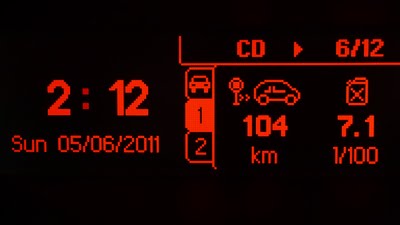
Average Petronas PRIMAX 95 Xtra Consumption: 7.1liter/100km
Previous tests on normal RON95 never got less than 8liter/100km for driving the 308T around this 'gedebe & cas keting' state!

After travelling 620km on various types of road with different styles of driving the car consumed 44liters [3/4 tank] of Petronas PRIMAX 95 Xtra averaging 7liter/100km.
Balance 1/4 tank. Already topped up and ready for Day3 600km-return trip.

Day 3: June 6th 2011
Sector 5 - Non Stop Return Trip. Had to detour towards Kuala Berang before joining ECE due to heavy traffics on the way to Kuala Trengganu. Skipped passing over or stop at major towns. Reduced traveling distance from 620km to approx 590km.

40% Hi-ways [above 100km/hr] , 50% Trunk Roads [80~100km/hr] , 10% other roads [below 80km/hr]

Fuel left after 589km drive...

The over all fuel consumption for the 1209km journey was 84 liter [around RM160 @RM1.90/liter] of Petronas Primax 95 Xtra [PP95X].

________________________

The 225/45/17 CSC3 tyres had been abused at the end of their life at some points of this journey...

December 01, 2009

Thanks God! It was Peugeot 308T

Even though I knew that Peugeot 308T had a long list of safety features, I was never really impressed compare to its own outstanding handling and road-holding until I experienced myself the life savers that it had.

My first experience was while doing downhill duel with a proton Waja 1.8 around Bukit Tinggi/Berjaya Resorts. Knowing I was behind looking for an opportunity to overtake, this bugger responded even though we were approaching a slippery right-turn curve. He seemed to be an experience driver but he pushed the the Lotus Tuned Suspension Car to the limits until it over-steered with rear tyres skidded sideways [or fish-tailed] and ended in the monsoon drain. While maneuvering to avoid a collision, Peugeot 308T tyre adhesion and dynamics were also at their limits. I thought I was on a boat. At a flick of a second the ESP light started to flash and the car regained its course and negotiated in the direction it was intended.

Everybody who drives on federal roads to or from East Coast states will normally experience trailing long Q's behind slow vehicles. Driving any car with ample torque [and low kg/bhp ratio] no one is patience enough because overtaking a Q of vehicles on a straight stretch is 'a breeze'. But be careful! what if a car or two in the Q suddenly change lane and appear in front of u for the same purpose? Worse still when they make a sudden right turn? Almost everybody will involuntarily hit the brake. I had this experience with my308 too. The cars sensed an emergency braking and EBA [Emergency Braking Assist] took over by braking to the max and at the same time hazard light turned on. In the process ABS also came into play.
P1090993a
Last weekend I was driving back from Kelantan in heavy rain. As usual I had a bad habit of diving the same speed whether it was raining or dry, sometimes even faster when it drizzled or rained. While I was overtaking at a gentle curve I hit a long pool of water, suddenly I felt 'jerky' as if the engine was switched OFF and ON a few times until the traction was regained. It was actually a combine effort of ASR, ESP and DSC that saved my family and my life...
P1090994a
The following are the dynamic safety features that Peugeot 308T have and proven their effectiveness. I've tested involuntarily and w/o intention.

EBD - Electronic Brake Distribution
EBA - Emergency Brake Assist
ASR - Traction Control
ESP - Electronic Stability Program [watch video]
DSC - Dynamic Stability Control [watch video]
ABS - Antilock Braking System [watch video]

Almost all new cars are now equipped with ABS. But it is important to remember that ABS will not shorten stopping distance, in fact it can extend beyond that of threshold braking in a non-ABS equipped car. ABS is mainly for an emergency situation to prevent brake lock-up in order to maintain steering control to steer clear of an obstacle thus avoid collision. Do not attempt to modulate the brake - the ABS system will take care of the modulation. For cars without EBA however, to correctly use the ABS brakes in a panic situation, the driver must apply the brakes 100 percent, using all available force and steer accordingly.

Happy Motoring and always...
Berhati2 d'Jalan Raya


|Home|Fuel Consumption|Performance|uncle's DIY|Car Size Comparison|

May 17, 2009

On Emergency Call to Kelantan...

Thursday, May 14th. I received an emergency call just before 6:00am. Got up immediately to pack-up and had to leave for Kelantan by 7:00am.

Unfortunately just after passing through Sungai Besi toll plaza there was a massive traffic jam on E2 and MRR2 all the way till Hulu Klang. It took me almost 3 hours to arrive at Gombak toll plaza from my home in SKV - lost two solid hours already. Had to 'eat' the remaining 380km in four hours. Quite a difficult task to drive on non-expressways with heavy traffic. The GPS navigator registered ETA 3:15pm! I must drive to the extreme to reduce the journey time by at least 1hr 15minutes in order to arrive at the final destination before 2:00pm.

I was expecting it could be done with the 308THP in less than four hours though! Nevetheless I had to set the speed limiter to 190kph 'only'. I got spirited. I like the first 40km stretch on E8 Karak Expressway where I could push the car to the extreme limits before exiting onto Federal Road #8 towards Bentong.

By the time I left E8 the GPS registered ETA 2:50pm. Then at KLipis the ETA reduced 2:35pm... and kept dropping as I sped of but just after that I had to stop [by the order of traffic police] for 10minutes or so to give way to some kind of bicycle racing.
Then I kept on 'tekan'ing the accelerator pedal all the way. By the time I arrived GMusang the ETA was reduced to 2:15pm and kept dropping as I burned 30~40% more fuel per 100km than usual. At KKrai junction the ETA reduced to 1:55pm. With 5-minutes reserve I could slow down to the speed limits... finally arrived at the destination @1:57pm safely but the EP6DT engine consumed almost 3/4 tank of fuel. Previous economy RETURN trip KL-Kelantan-KL consumption was less than one tank of 60liter gasoline covering more than 800km w/o refuelling along the entire journey.

BTW, three other cars which had left Klang Valley 1-hour earlier than me arrived between 45-90minutes later! I'd overtaken them around KLipis.

|Home|Fuel Consumption|Performance|uncle's DIY|Car Size Comparison|

March 23, 2009

myPeugeot 308 Fuel Consumptions

Between March 14th ~ 20th, 2009 I traveled around two thousand kilometers on all types road in Peninsular Malaysia to test-drive Peugeot 308THP for reliability, handling, power, comfort as well as fuel consumptions.

Fuel Consumptions

As far as the fuel consumption is concerned, Peugeot 308 THP can be a relatively frugal car when pushed gently and steadily [w/o pumping] on the accelerator pedal at moderate speeds, but can be very thirsty when driven hard.

Note: Driving below 65kph increases fuel consumption inversely proportional to the speed at which AL4 sticks on 3rd or lower gears.

Achtung!: Flooring the accelerator pedal during 'taking-off' this little twin-scroll turbo engine will consume up to 30liter/100km [3.3km/liter] ! - during which never ask how many mpg, just ask how many gallon to a mile does 308THP consume...


Distance traveled: 2268km

[click-on the picture for higher-resolution image]


Exceptional Conditions
1. Traffic Jam - along MRR2/Karak h/w on day1 school holiday rush hour.
Average fuel consumption: 11.8liter/100km [8.5km/liter or 24mpg!]

2. Start-Stop Driving - along Kelantan state/kampong roads while road-trackings for a local GPSmapping community.Average fuel consumption: 9.2liter/100km [10.9km/liter or 31mpg]

3. Economy Run - AutoCruise from Gua Musang to Machang . The traffic was smooth. Speed around 50~90kph.
Average fuel consumption: 7.3liter/100km [13.7km/liter or 39mpg]


Range
Between March 19th~20th, I drove 740km [excluding 40km remaining fuel in tank as displayed by the on-board trip computer] without refueling in between. Giving an average fuel consumption of 7.6liter/100km [13.2km/liter]
70% of the journey was on auto cruise within 10% speed limits.

On the last 50+km [about 7% ] the car was driven at almost full throttle on NS-highways at very high speeds "to introduce" what Peugeot 308Turbo is. Hee heeee...just kiddin'.

I can conclude that Peugeot 308 THP can easily be driven [at legal speeds] up to 800km w/o refueling , especially on auto cruise.


myPeugeot 308 Driving Impressions
Already written earlier. Click HERE


click on for Related Travelpics

frequently visited pages:
|Home|Fuel Consumption|Performance|uncle's DIY|Car Size Comparison|

March 13, 2009

2Thousand-km Test Drive

The 2Thousand-kilometer test-drive starts on March 14th
400journey
Tentative Routes
Stage #1: KL-ITM Jengka, Pahang
Stage #2: Jengka-Jerantut [near Taman Negara]-KLipis-GMusang-Machang
Stage #3: Around Kelantan including Sungai Bagan offroad
Stage #4: KB-KT-Kuantan
Stage #5: Kuantan-Pekan-Endau
Stage #6: Endau-Mersing-Kota tinggi-JB
Stage #7: JB-BPahat-Muar-Melaka-Klang Valley

Pre-trip Preparations
1. On-board Navigation System, Tracker and Datalogger.

2. 'First-Class Seat' c/w Sleeping Berth for a special rear passenger

3.Luggage

4. Ready to leave


|Home|Fuel Consumption|Performance|uncle's DIY|Car Size Comparison|

February 02, 2009

Advanced Driving

Today's top racing drivers have a superb sense of balance and feel for the car on the track. They are usually in complete control of the vehicle, but they often stress it beyond its limits. The skills and temperament needed to win and the refusal to give an inch, even when cornering to the limits of the car's adhesion makes track driving techniques and mental attitudes completely wrong for everyday driving.

Having performance stock street-cars such as Peugeot 206GTi and Peugeot 308GT [Andy and Alan, Hi!],
...is "meaningless" if the driver thinks that there is a egg between his right foot and the accelerator pedal. However it could be very dangerous driving such cars agressively without driving skills.

There are courses available in Malaysia designed for drivers who wish to take their driving skills to the next level. Such Advanced Driving Academy gives spirited drivers the opportunity to push a little harder, learn more driving techniques, and explore 'high end' vehicle control skills at the critical limit, in a safe and non-threatening environment and provides the skills to plan driving in terms of making safe and efficient use of road space. It will build up confidence and turn casual drivers into a decisive driver whether they are always at the right part of the road, travelling at the right speed in the right gear and never making unnecessary jerky moves or sudden changes in direction.

An accident or even a near miss usually represents a loss of this control. Advance driving techniques help improve driving skills by increasing driver awareness of the range of factors that affect driving, such as :

- own capabilities
- the characteristics of vehicle
- and the road and traffic conditions.

It could save our time, money and life. In Malaysia, an average of 18 people killed in road accidents each day and 100 are seriously injured.

Do we think any of them expected this to happen?


Be prepared!

Last 7-day Most Viewed Pages

All-time Most Popular Posts