December 26, 2010

Post 30,000km Inspection, before leaving again....

Before leaving I normally spent almost a half day to clean/tidy up everything I left at home, including cars...
I did inspect undercarriage as well....
... and found no traces of oil leak anywhere of any kind even after almost two years of abuse. To date AHW308 is free from infamous oil leak.
So far already three counts of oil change, every time filled up 4.25 liter after draining and the filter cart replaced- it is not true filling more than 3.7 liter will make oil seeps out. Probably the first batch [CBU species] which needs 4.25 liter of oil is different from the later batches...
Original CSC3 225/45 R17 tyre condition after 35,000km... makan evenly and never need balancing since day 1. Probably will last beyond 40,000km!


HAPPY NEW YEAR 1.1.11 everybody.

"Will be back....!"

December 22, 2010

DTUKship for under RM2k?

Believe it or not a few of our 308 fellas got DTUK for under RM2000! I've got no comment but u can find out for urselves what sort of DTUK our friends got. Click HERE.

December 19, 2010

Projector Lenses

Updated - Dec 22, 2010
Peugeot 308 H7 Halogen lights are bright enough for normal driving but still not sufficient for high speed driving at night [worse still if it rains]. At first I replaced them with NightBreaker bulbs but still not good enough ...

Then I installed HID Xenon kit [color temp 4300K] at the end of Q1 this year. Very bright but the parabolic reflectors were actually not designed for HID use.
As a result there were too much glare for the comfort and safety of drivers coming in the opposite direction. I was thinking to find a solution then...

I learned that a pair of Projector Lenses were required to be placed in front of the super bright HID tubes to correctly focus the scattered beams hence reduce glare and improve light distribution.
Just installed a set of 3" Projector Glasses [lenses] for the H7 HIDs.


Projected light beams on the wall...
Now no more glare to the incoming vehicle drivers...Circular Cold Cathode Fluorescence Lights [CCFL] tubes were also installed c/w inverters.
The CCFL side lights [angel eyes] look really cool.The installation wasn't easy. Even the expert hands took almost 10hrs to do. Never try do it yourself if you are not patience enough. Thanks Desmond Lim for your patience and passion. Very good job done indeed.
The 'E46' Projector Lens is 3" in diameter - not exactly 'ngam'. Probably 3.5" glass would be better but couldn't find locally [yet] .


After the installation, final beam realignments [horizontal and vertical] were required. Click HERE if u want 2 c how 2 do it.

Even though projector lenses cut out glare significantly, beam height still needs adjustment to avoid causing a nuisance to other road users. The manual headlight height adjuster is located to the right below steering column.

From lowest to highest...
_
_
Note: Beams are not sharply focused though. Some evidence of penumbrae exist. Since those lenses are not multi-coated there are some fringing too.

Projector-HID on the road...

December 16, 2010

What Makes Car to Accelerate? Torque or Horse Power

Any wild answer? BTW my answer is simple... 'torque' makes you a winner and 'horse power' makes you a buyer. Think for a moment or read my previous post. I'll be right back.

December 13, 2010

ECU Reprogramming

During those good 'ol days, when cars like Alfa Romeo Giulia, Datsun SSS, Fiat 124ST, etc.. ruled the streets I was still a teenager in a technical secondary school. After graduation from tertiary education I only could afford a 'poor man's Alfa Romeo'.

The only inputs to alter engine performance at that time was a mechanical actuator based on centrifugal force in the distributor which advances ignition timing as the engine RPM increases and a vacuum actuator to retard ignition timing when the accelerator pedal was released.


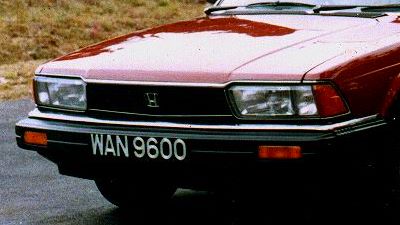
My first Honda [poor man's Alfa-Romeo] - yr 1979 stratified charged 1.5 liter 12v Civic (sold 1n 1983)

Improper ignition timing would induce 'explosion' or/and 'knocking'. A krypton timing light was normally used to correctly set ignition timing. Sometimes a few more degrees offset from the 'correct setting' to advance or retard sesedap rasa. Spark plug and contact point gaps were also adjusted by trial & error to squeeze out every fraction of bhp. For those who were willing to spend more gallons per mile invested on Weber carburetors.

Then around 1980's electronic ignition was introduced in this country for car engines to vary the timing to a greater degree than a fixed ratio advance curve.
My 2nd Honda [poor man's BMW] - yr 1983 has electronic ignition (sold in 1994)

A complete 'map of variables' was entered into the ignition program and preset timing would be read from a table. Later with the advent of modern technology and introduction of programmed fuel injection, cars have been made smart and their performance tuning has been made even simpler.
My first car with programmed fuel injection engine...yr1994 (well kept and still running)

Today engine tuning can be performed via microprocessors or computers. Car engines can be made more efficient, producing more torque [and power] and become economical as well as far as fuel consumption is concerned. This all results can be achieved by reprogramming car's ECU or 'firmware upgrading' or whatever terms you may call it.

400P1110649
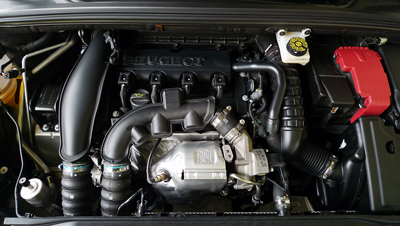
My 5th Peugeot - yr 2008 308T , my first attempt on Turbo Car ....

Now air temperature, engine speed, engine load and even control over turbo waste gate control means that precise management of the engine ignition timing is possible and the optimum output throughout the rev range can be achieved.

What is ECU reprogramming
Different car's performance parameters are now judged by sensors embedded at various places in the car. These parameters may include ignition timing, fuel consumption, air flow, throttle position, crank position e.t.c.

All these are closely monitored via sensors and their performance reports are send to car's engine management system or electronic control unit (ECU). So ECU basically is a software program which process the signals send by the sensors and helps in better performance of the car in any given condition.


Why need ECU reprogramming?

Of course for better engine performance...
The car manufacturers do not always tailor make their ECU settings at optimum performance level. It may sound ironic or weird for all car enthusiasts but its a fact. The logic behind it is that the production cars are also aimed for all the end users and make sure that their product is well enough for almost every condition.

ECU reprogramming can be done by just overwriting the existing program and replacing it with a more tuned software to fit for purpose. Previously was done by removing the existing chip containing the software with a 'super chip' . Today, it has been made easy after the advent of serial port reprogramming, and now ECU reprogramming can be performed by just plugging and overwriting engine map by a better 'firmware'.

Reprogramming ECU can be a simple performance upgrading by pro-tuners but it may become complicated to some tuners who are not aware of the car's specification including transmission and would end up in creating a mess because they do not pay consideration on 'how the car engine is going to behave' under endurance.

ECU reprogramming may have some fuel implications if you want to squeeze out every remaining pony available. However 308T car can be tuned to an optimum level, a compromise to save fuel and raise the torque as well. It is believed to achieve an increase of around 30% in max torque... but how the torque curve is going to be is another story.

Why wouldn't I go for ECU firmware upgrade yet?
The answer is ... "still analyzing a few options available..."


December 11, 2010

Stage 1 Tuning

Stage 1 Tuning is something that just about every 308Turbo owner wants do sooner or later. But what is it?

Typical Stage 1 Tuning Kit*

It is supposed to be the first stage of bringing a standard production model to life. A standard 308Turbo is restricted by the regulations in terms of its performance and also in the emissions (exhaust gases) that it gives out. These regulations are enforceable by laws and standards in the country of 308 origin... probably not applicable else where, and of course in Malaysia, boleh... so some people believe stage 1 tuning brings the car back to the performance it was designed for.

Just surf the internet and u can easily find what stage 1 tuning is all about - but don't get poisoned too fast and never over do and mix up with stage 2 and stage 3 modifications without really understand how your car is going to perform .

Click HERE for more info on tuning stages.
____________________________________________________
*Not all kits are useful for 308Turbo. Read MOTORING MYTHs and TUNING MYTHs and FACTs.

What Engine Tuners Don't Tell You

PART 1

First and foremost let me define...
An Engine Tuner is a person who does the adjustment, modification, addition and alteration to the internal combustion engine components (software or/and hardware)to alter its performance, to change the engine output characteristic (torque curve vs rpm, hence horsepower), fuel economy, durability (or any combination of those).

It is a norm for any engine tuner to tell you what will be the expected improvement in maximum torque and maximum horse power after the what so called tuning is done for your car engine. Probably you believe it after taking a short spin when your car had been successfully tuned...

You are so happy when a gentle tap is applied on the accelerator pedal the car seems to be flying... and you tell the whole world without knowing your car engine will be out of breath before reaching the new record breaking top speed.... then you became frustrated!

For instance, an n.a diesel engine car also behaves like that. A diesel engine of the same capacity even has higher maximum torque than petrol powered engine. But how come a car powered by n.a diesel engine is so sluggish in century acceleration and 400m standing? However, a turbo diesel engine has a totally different story.

Now, there are something that some engine tuners don't tell you. While a few are pro enough letting you know some..., if not all. I'm not paid to make any recommendation but you will be able to decide what's not and where not to go to tune-up your car.

Before I proceed, probably you need to refer back to your old school book to find out the relationship between TORQUE, RPM and HORSE POWER then come back. I'll wait.
__________________________________________________


PART 2


Most people are confused about the relationship between POWER and TORQUE. We often heard engine tuners ask customers:

"U mau improve HORSEPOWER atau TORQUE aah?" in a tone which strongly suggests that these 'experts' believe power and torque are somehow mutually exclusive.

In fact, the opposite is true, and you should be clear on these facts:

Horsepower is dependent on TORQUE and RPM. Torque and RPM are the MEASURED quantities while HORSEPOWER is CALCULATED from the product of torque, RPM and a constant figure. For time being forget about the 'constant figure' . What you should know now is:

HORSEPOWER is proportional to TORQUE x RPM inclusively (but the horsepower is not necessarily proportional to torque or rpm exclusively)

Remember that, torque and horse power do not work together. Horse power is a result of the the torque applied at specified rpm.

Got this? Good. Now think for a moment... what makes a car to accelerate? Torque or Horsepower?

__________________________________________________


PART 3


In my studies I categorize torque curves in three difference types. Each type has its own application, one of them may suit ur driving style. I'll explain later.

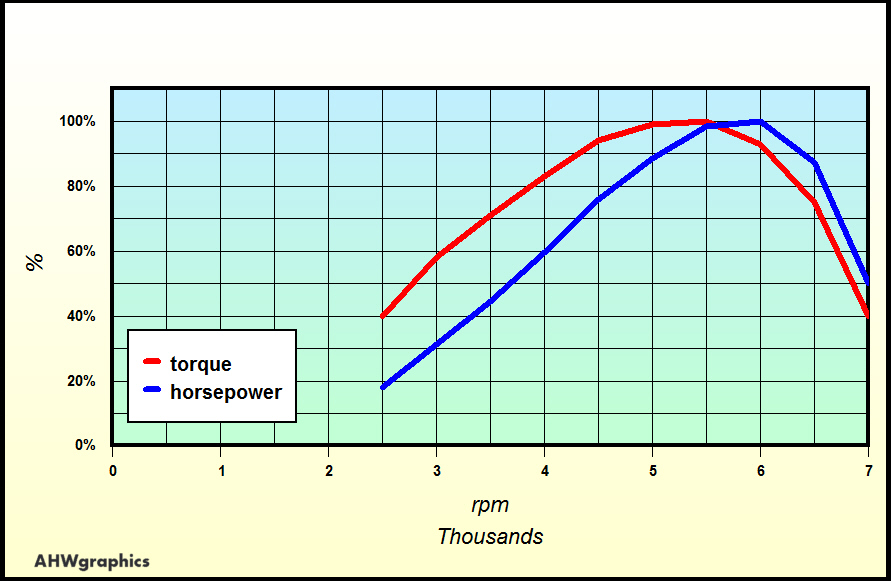
The following are different type of torque vs rpm charts and the calculated horsepower in p.u values. (Taking maximum torque and horsepower as 100%).

Type 1: Low-Rev (narrow) Power Band


Type 2: Mid Range (wide) Power Band


Type 3: Hi-rev (narrow) Power Band


BTW, our Peugeot 308Turbo torque is Type 2 . Relatively wide power band at moderate engine rpm. AL4 transmission is good enough. In tiptronic mode, in 3rd gear the car can accelerate aggressively from 70km/hr to 145km/hr and still has enough torque to ultimately reach 160km/hr w/o shifting up. On 4th it can pull away easily from cucukers behind you from 90km/hr to 190km/hr before the engine is out of breath and lifeless after touching a few km/hr above 200.

Pls take note... even though some n.a cars with bigger engine capacity which accelerate at slower pace below 190km/hr still be able to accelerate all the way beyond our stock 308 top speed... don't play play with them above 190km/hr... unless we tune up our car in such a way the torque curve is extended further into the redline, hence increasing maximum horse power!

You need a suitable tuning kit and remapping... w/o even increasing maximum torque too much. The key word is EXTENDING the useful torque curve further into the red zone!

Ada tuner boleh bikin ini macam kaa?

__________________________________________________


PART 4

When a close-ratio or 6- or 7-speed transmission needed?

A car having six-speed and even seven-speed transmission can not be legitimately called "close-ratio" for performance driving. Probably it is not better than a car equipped with a standard 4- or 5-speed. It actually has extra high overdrive gears for leisure and economic hi-way cruising.

However if it keeps the top gear ratio about the same as in a comparable 4- or 5-speed transmission, and rather distributes more closely spaced ratios among the lower gears, then YES it has a 'closer-ratio' transmissions so to speak.

For instance a 5-speed transmission can be a close ratio too as shown below:
... the 5-speed stock transmission is actually a 4-speed with an over drive.

When do u need a close-ratio transmission?
The answer is when you got dyno chart as shown in Type 1 and Type 3 in PART 3 where power band is relatively narrow.

What is the significant of Type1 and Type 3 and where to use?
Ask you tuner for the answers.

So do not simply upgrade and lanyak ur car w/o knowing how it is going to perform and whether the power band ngam or not with the existing transmission . Otherwise u will be a born looser even before the red lights are off....

'HAPPY MOTORING'


December 03, 2010

How to Cool a Hotspot?

If u own a 308, most likely u also have a 3G smartphone (or more) with Wi-Fi and...

Probably u might have already been using it as a Wi-Fi hotspot for connecting ur Wi-Fi enabled devices to the Internet. If u haven't done so for not knowing ur smartphone capability take a look HERE, no one is peeping, hee....heeeee

There is one problem though. The hotspot can be extremely hot. The heat generated can damage ur precious device during extended use. But don't worry and u don't have to place it in refrigerated glovebox or somewhere out of ur sight. U can make it freezing cold and at the same time u may place it at a strategic location on ur 308 dashboard for normal use too, such as for gps navigation.....

All u need is a smartphone holder that can be fixed onto ur middle aircond vent....
...which u can buy @pasarmalam for +-RM10.00, u may also need an in-car charger because when u turn on the smartphone as a Hotspot and worst still u turn on the gps navigation at the same time, the bugger eats up lots of battery charge, just like ur 308T's do, hu huu..

Now u can have a cool hotspot in ur 308 to make ur passangers or urselves [if u r x drivin' la] enjoy the long trip with iPod Touch, iPad or any other tablets that do not have 3G.If ur rear pasengers are addicted to podcasts they can download and play their favorites on iDevice which can be attached on the back of the front seat...
... and of course I like watching IRC too whenever I'm in the backseat....
So, if u wanna buy an iPhone... think again because u can buy much lower-cost iPod Touch or even an iPad [or BOTH, he heeee] at a fraction of the price, and u do not have to get rid of your old faithful 3G SmartPhones.

Last 7-day Most Viewed Pages

All-time Most Popular Posts